
Transparency arises when the lava solidifies before it has time to crystallise. The earliest dated finds of window glass are said to come from Pompeii and the eruption of AD 79: square panes measuring 70 cm a side. The Romans cast their panes, but later began to blow them. The art of making glass spread across the Roman Empire and took hold in ancient Gaul and other northern provinces.
A thousand years later the circle closed, when glassblowers from Normandy settled in Italy – the origin of what were to become the world-famous Venetian glassworks on Murano, a small cluster of islands in the lagoon off La Serenissima.
“Putell på dig, mon frère,” Bellman, one may presume, exclaimed – with an engraved glass from Limmared in his hand.
Swedish glass and Småland’s Kingdom of Crystal
Swedish glass has a success story of its own. Small glasshouses appeared as early as the reign of Gustav Vasa. The first proper glassworks was founded in 1594 on Älgön in Lake Mälaren by a German master. During the Age of Liberty in the 18th century, production took a great leap forward, as the state and the Estates encouraged the founding of domestic manufactories.
By the end of the 19th century, the Småland glassworks lay so close together that people began to speak of the Kingdom of Crystal. Kosta, Boda, Orrefors, Skruv, Pukeberg, Åfors and Målerås gradually conquered the world with their craftsmanship. Artists such as Simon Gate and Edward Hald made Swedish Grace a byword. To this day, Sweden is a world leader.
From wind-eyes to machine-rolled glass
But it would take time. At first there were only small holes to let the smoke out; the light came as a bonus. They were called wind-eyes, or daylight openings. Gradually the openings were covered with stretched animal hides, scraped so thin that they were almost translucent. Ox bladders were used too, as were membranes from cows’ stomachs and oiled linen, while shutters became ever more common.
Only in the 16th century did glass become somewhat more common in Sweden, and even then it was strictly reserved for the rich and the noble. On the Continent, castles and cathedrals had for centuries been built with shimmering rows of windows and breathtakingly tall mosaics telling biblical stories in glass, all set in lead.
Lead made it possible to join large windows out of fragile glass. But lead is a metal not particularly well suited to glazing bars, and in Sweden it was replaced by timber in the 18th century. Much later, lead returned as a decorative element in Art Nouveau and Classicism.
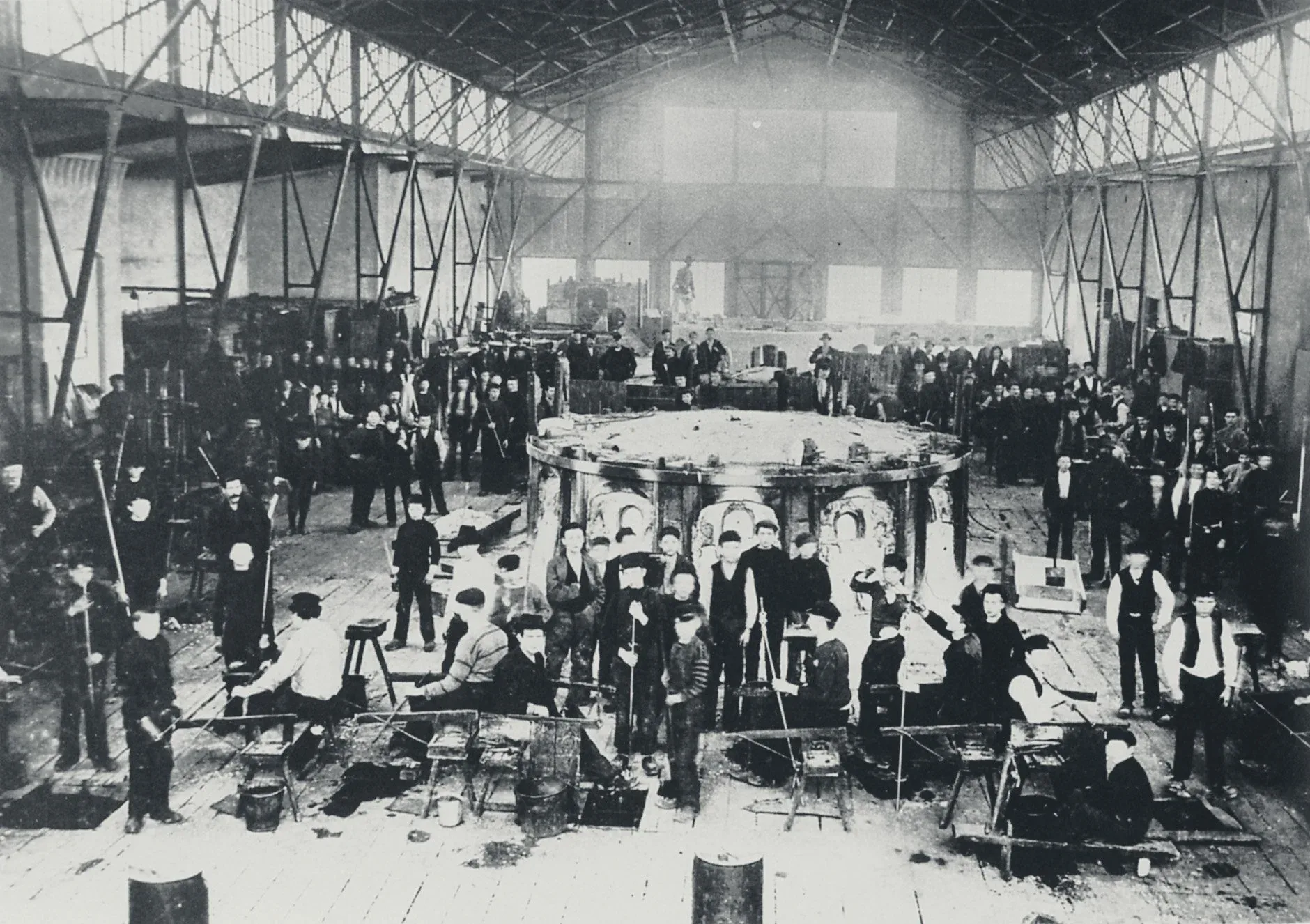
Most things in history happen earlier than one might think. In 1688 the Frenchman Bernard Perrot patented the machine production of glass, a method that allowed sheets of more than 1 × 2 metres to be cast. Yet well into the 20th century, window glass in Sweden was still made by hand and mouth, with wooden ladles and swing pits. The glowing gather of molten glass was blown into a cylinder, which was cut and opened with a red-hot wire and a cracking iron, then flattened in a flattening kiln and left to cool.
“Entire glazed partitions can be load-bearing. Something Le Corbusier could only dream of.”
Lenhovda, the present day and pure light
Mouth-blown glass was gradually replaced by drawn or rolled glass. In the 1920s the first machine for making window glass came to Sweden. Today, the Pilkington brothers’ method is the standard. In the 1950s they launched their float glass: the molten glass flows out over a bed of molten tin, evenly and smoothly. It is called flat glass. Gone are the bubbles of the old poured glass, the variations and the faint bottle-green tint – and with the craft, perhaps, the beauty disappeared too. But the light remains – and a different kind of beauty.
A pane of glass does not make a window. It takes more than that. Without the lining, frame, posts, sash and glazing bars, there is no window. It’s that simple.
Window joinery is a noble art with roots in history, not least in Småland, handed down through generations. Glass and wood are in the region’s DNA. Our production is in Lenhovda, in the heart of the Kingdom of Crystal, in the middle of the Kingdom of Furniture.
Traditional craftsmanship in timber will always be the foundation of what we do. Our joiners have served their apprenticeships – skilled craftsmen made of the right stuff. They work with a production line of the very highest quality. Let There Be Light is joinery and high technology in one.
We make doors, windows and sliding doors in timber and glass with an advanced lift-and-slide function. Timber is combined with innovative materials. Our glazed partitions can be fitted with solar shading, electronic dimming and motorised operation. The sliding doors run on ball-bearing rollers. The lift-and-slide function is easy to operate and allows even a heavy glazed panel to run lightly and silently. Angled profiles seal timber against timber when the door is locked.
Entire glazed partitions can be load-bearing. Something Le Corbusier could only dream of. His open floor plans and ribbon windows required concrete columns in the façade.
Our philosophy
Ma, pronounced “maah”, is an ode to the inherent beauty of emptiness. A homage to the space in between, rather than to the things themselves. A tribute to the void – the negative space. The surfaces that bind everything together.
Ma is a concept rooted in Japan – in architecture and interior design, but also in garden aesthetics, music, flower arrangement and poetry. Ma is a large part of Japanese life itself.
Alongside Ma, our primary emphasis lies in staying true to our materials. By no means a ground-breaking idea, but a well-founded architectural theory that is well worth pursuing. Truth to materials is a fundamental idea, rooted in the notion that materials should find their most suitable applications without any attempt to conceal their intrinsic qualities. The aim is to use materials in their unaltered, most honest form.
This principle is one of the cornerstones of our product development, together with the theory of negative space. 間.
In truth, what we make is light. There is always a story, short or long. Ours is short – and long.
Fiat lux. Varde ljus. Let There Be Light. And there was light. Och det vart ljus.
We work with this light every day. Talk about a product with provenance.